Spotting Carpet Beetle Damage Before the Spring Breeding Cycle Begins
As winter’s grip continues in Canterbury, we naturally spend more time indoors and keep the chill at bay with heat pumps, log burners and draught-stops. But this cozy indoor environment creates an unintended consequence: ideal conditions for carpet pests.
While outdoor insects remain dormant through July and August, indoor heating allows pests like carpet beetles survive easily. Hidden beneath heavy lounge suites, along dark skirting boards, and within undisturbed wool carpet pile, carpet beetle larvae actively consume natural textile fibres throughout the winter months.
If left unchecked, larvae will transition into their adult stage as temperatures warm up, initiating a spring breeding cycle that can cause extensive, costly damage to textiles throughout your home. Identifying the early warning signs of carpet beetle activity in mid-to-late winter is your best opportunity to protect your textiles before spring arrives.
1. Understanding the Carpet Beetle Life Cycle
To combat carpet beetles effectively, you need to understand the life cycle stages, and which of them is the target stage for effective eradication of them from your carpet.
The lifecycle moves through four distinct stages:
- Adult Egg Laying (Late Spring & Summer): Adult female beetles lay between 40 and 100 eggs in dark crevices, wardrobe corners, or underneath undisturbed furniture.
- The Larval Destructive Phase (Winter): Known as "woolly bears," these larvae actively feed on natural keratin protein for 9 to 24 months. This is the stage that causes severe fabric damage.
- The Pupal Transformation (Early Spring): Larvae transform in quiet, static spaces as temperatures rise.
- Adult Emergence: Fully formed adult beetles emerge and fly towards natural sunlight to feed outdoors and repeat the cycle.
The Adult Beetle: Harmless to Fabrics
Adult carpet beetles—most commonly the Varied Carpet Beetle (Anthrenus verbasci) or the Australian Carpet Beetle (Anthrenus ceramicus)—are small, oval insects measuring roughly 2 to 3 millimetres in length. They display a mottled pattern of white, brown, and yellow scales. Adults do not feed on fabrics. In fact, they feed exclusively on pollen and nectar outdoors and are naturally attracted to sunlight. If you see tiny, round beetles crawling near windowsill frames in spring, it is a clear signal that an active breeding population has successfully matured indoors.
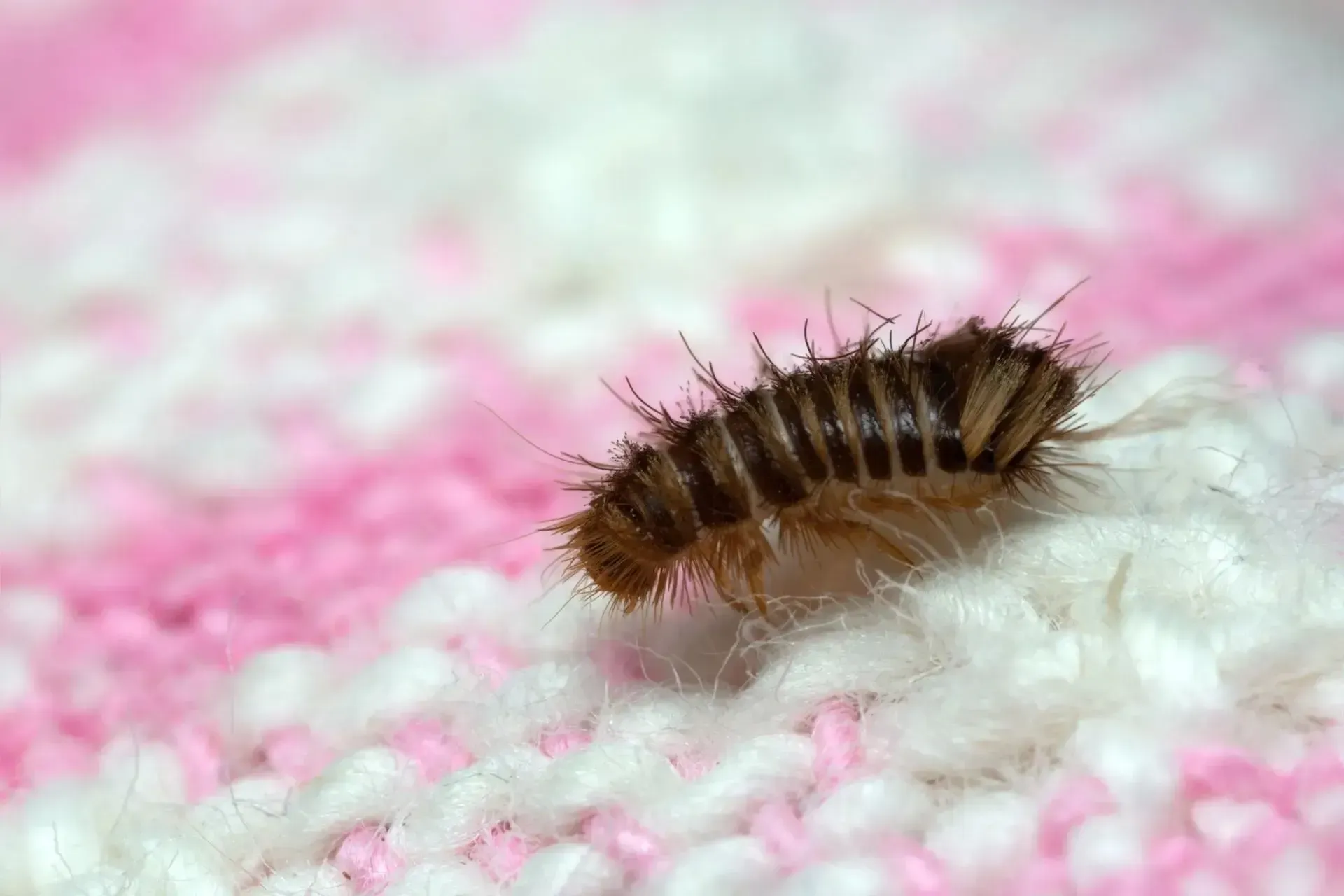
The Larvae ("Woolly Bears"): The True Fabric Destroyers
The real destruction is caused entirely during the extended larval stage. Carpet beetle larvae—often referred to as "woolly bears"—are elongated, reddish-brown grubs covered in dense, microscopic bristly hairs.
A single female carpet beetle can lay dozens of eggs in dark, undisturbed locations rich in organic food sources. Once hatched, larvae can remain in this destructive feeding phase for anywhere from nine months to over two years, depending on indoor temperature and food availability.
2. Why Wool? The Biological Target
Carpet beetle larvae do not eat synthetic nylon or polyester for nutritional value, although they may chew through synthetic blends to reach organic spoils. Their biological target is keratin—a tough, fibrous structural protein found abundantly in natural animal fibres.
In a typical New Zealand home, keratin sources include:
- Pure Wool and Wool-Blend Carpets: The primary target in older Christchurch residences.
- Woollen Rugs and Tapestries: Particularly fine Persian or oriental rugs placed over underfloor heating.
- Natural Fibre Upholstery: Feathers, horsehair padding, leather, and woollen upholstery fabrics.
- Clothes and bedding: Merino, alpaca, cashmere, silk.
- Accumulated Organic Debris: Human hair, pet dander, sloughed skin cells, and natural lint trapped under heavy furniture.
Because modern Christchurch homes are insulated, double-glazed, and held at fairly constant temperatures, larval growth accelerates during winter. The warm indoor ambient temperature provides ideal conditions for non-stop feeding right when homeowners least suspect it.

3. Five Subtle Signs of Winter Carpet Beetle Activity
Because carpet beetle larvae instinctively avoid light, they rarely crawl across open floor areas. Instead, they work quietly in dark, static zones. To spot an infestation before the spring population surge, inspect your home for these five warning signs:
Sign 1: Irregular, "Shaven" Threadbare Patches
Unlike moth damage, which often leaves loose, sticky webbing suspended across carpet surfaces, carpet beetle larvae graze methodically along the base of the carpet pile. They shear off natural wool fibres at the base.
Look for irregular, threadbare lines or patches along perimeter walls, beneath floor-length drapes, or directly under heavy couches and sideboards. The damaged area will appear clean-cut or "shaven," as if tiny scissors trimmed the tufts away from the backing.
Sign 2: Cast Larval Skins
As carpet beetle larvae feed and grow, they moult repeatedly, shedding their hard outer skins up to a dozen times before pupating. These cast skins are light brown, translucent, hollow shells covered in fine bristles. You will often find them accumulated along skirting boards, inside dark wardrobe corners, or beneath bed frames.
Sign 3: Fine, Granular Frass (Larval Droppings)
Larval droppings, known as frass, are tiny, hard, sand-like granules that match the colour of the fibre the pest has been consuming. To the untrained eye, frass is often mistaken for ordinary beach sand or fine dust. However, if you find concentrated deposits of fine grit beneath heavy furniture or along carpet edges where nobody walks, it is likely larval frass.
Sign 4: Perimeter Thinning Along Skirting Boards
Carpet smooth-edge strips installed along room perimeters create a small structural gap between the skirting and the carpet backing. This dark crevice collects pet dander, lint, and moisture, making it an ideal breeding ground for young larvae. Gently pull back carpet edges in hidden corners; if the pile pulls away effortlessly or exhibits severe edge thinning, active larvae are present.
Sign 5: Unexplained Damage to Woollen Garments and Blankets
If woollen throws, winter coats, or feather cushions stored in dark closets develop small, clean-edged holes without any visible sticky webbing, carpet beetle larvae have migrated from the flooring into your soft furnishings.

4. ‘Solutions’ That Aren’t Solutions
Discovering carpet beetles often triggers a panic response. Many homeowners reach for consumer-grade aerosol bug bombs, surface pest sprays, or aggressive DIY vacuuming. Unfortunately, these methods rarely eliminate an established infestation.
- The Bug Bomb Illusion: Total-release foggers fill the centre of a room with fine pesticide mist, but they fail to penetrate beneath heavy furniture, deep into carpet pile, or into the tight crevices behind skirting boards where larvae hide. Furthermore, foggers (unhelpfully) leave chemical residues on open surfaces and furniture.
- The Vacuuming Limit: While regular vacuuming is essential for general maintenance, standard domestic vacuum suction is not enough to dislodge all larvae and eggs. Any left behind will Keep Calm and Carry On Consuming!
- Aerosol Surface Sprays: Over-the-counter contact sprays may kill an adult beetle on contact, but they lack the professional residual stability required to eliminate hidden egg hatches over a multi-month period.
5. The Best Approach: NZQA-Certified Urban Pest Management
Some things are best left to a professional. At Advanced Carpet Cleaning, our NZQA-certified team can advise on all aspects of eradicating a carpet beetle infestation. We recommend an integrated approach:
- We may suggest adjustments to your indoor environment to make it less appealing to carpet pests.
- We can apply a professional-use spray directly to perimeter skirtings, under furniture footprints, and into architectural crevices. This formula is designed to interfere with the larvae’s ability to eat and reproduce, thus halting the larvae’s eat-pupate-lay eggs-hatch cycle before spring triggers a population explosion.
- We let you know what to expect in the months after treatment.
Protect Your Home Before Spring Arrives
Watching an adult carpet beetle wander over your windowsill in spring means the larval damage has already been done, and the infestation is on the up-tick. By taking a few minutes in winter to make an inspection of your home's dark, static perimeters and addressing early warning signs immediately, you can preserve the integrity, beauty, and value of your wool carpets and furnishings.
Tell us below how we can help. Our family-run, NZQA-certified team combines 30 years of textile care expertise with professional pest management to safeguard your Canterbury home.