The Molecular Science of Stains: Why Supermarket Sprays Are Sneaky
Reaching for the bottle of All-Purpose Carpet Cleaner that Nana recommended, you’re desperate for the effusive promises on the label to be true!
You spray, you scrub, and for a fleeting moment, you feel a sense of calm victory as the visible mark disappears into a cloud of white foam. All is well again in the world.
But then, a few days later, something strange happens. The stain seems to "ghost" back into view. Or worse, the spot where we scrubbed is now a much larger murky patch, getting darker by the day.
To understand why this happens—and why that $10 bottle of spray is often the most expensive mistake you can make for your carpet—we have to look at the molecular science of stains. Stay with us on this—it’s pretty interesting!
The Myth of the “Universal” Cleaner
The primary reason supermarket sprays fail is a fundamental conflict of chemistry. Supermarket shelves are filled with products that claim to be multi-purpose. They promise to tackle red wine, grease, mud, and pet urine with the same single formula.
From a molecular standpoint, this is impossible.
Different stains exist in different chemical categories. To remove them effectively without damaging the textile itself, you need a specific chemical reaction to unlock that specific molecule from that specific fibre type; a supermarket product that is strong enough to break down BBQ grease is not the right approach also for red wine.
When a manufacturer creates a "universal" spray, they are forced to create a jack-of-all-trades chemical. It is usually a high-alkaline detergent reliant on optical brighteners. It doesn't actually remove the stain; it may lighten it, or hide it, or it may simply dilute it which often enlarges the stain or pushes it down further into the pile.
The Three Pillars of Stain Chemistry
At Advanced Carpet Cleaning, we don't just see a brown spot. We see a molecular puzzle. Most household stains fall into one of three scientific categories, each requiring a completely different approach:
1. Synthetic Stains (Pigment-Based)
These include food dyes, ink, and many beauty products. These food dyes can (as you’d expect) dye fibres and fabrics. To remove them, we use reducing agents or oxidising agents that aim to budge the dye molecule without stripping the original dye of the carpet. The treatment agent and the dye stain must be thoroughly flushed out together.
A generic supermarket spray will often lack these specific agents, meaning it just wets the pigment, spreading it, and without extraction you now have the contaminant plus the cleaning product in the carpet.
2. Organic Stains (Proteins and Tannins)
This category includes "the big ones": red wine, coffee, tea, blood, and pet accidents.
- Tannins (Coffee/Wine): These are acidic. If you hit an acidic tannin stain with an alkaline supermarket spray, you can cause a reaction that effectively sets the stain in the carpet.
- Proteins (Blood/Urine): These require enzymatic cleaners. Enzymes are biological catalysts that consume protein molecules. While some supermarket sprays may claim to contain active enzymes, organic matter and its bacteria should always be fully flushed and extracted after an enzymatic treatment.
3. Petroleum and Lipid Stains (Oils and Greases)
Think of buttered toast landing face down, makeup, or the oily residue from a labrador’s coat. These are non-water-soluble. Using a water-based supermarket spray on an oil stain is like trying to wash a greasy frying pan just with cold water—it just smears the grease around. These require emulsifiers or dry solvents to break the oily bond.
The Power of Hydrogen: Why pH Matters
Aside from charring pencils over the Bunsen burners, do you remember much from high school science class? Remember how pH stands for “potential hydrogen”? See if you can dredge up a memory of the pH Scale, because this is where the most permanent damage occurs during DIY cleaning.
Harnessing the behaviour of hydrogen in a chemical application is key to ensuring a successful outcome. The pH scale runs from 0 (highly acidic – such as lemon juice, or vinegar) to 14 (highly alkaline – such as bleach, or caustic soda). Most high-quality New Zealand wool carpets are naturally slightly acidic (around pH 5.5 to 6.5). They are happiest and most durable in this state.
When you apply a high-alkaline product (pH 9 to 11) onto a wool fibre:
- It "opens" the fibre cuticle, making it rough and prone to matting.
- It can cause "fading" or "yellowing" that no amount of professional cleaning can ever reverse.
Professional technicians work to balance pH correctly. If we use an alkaline stain treatment, we follow it with an acidic rinse to bring the carpet’s pH back to its "happy place." Supermarket sprays don't come with a neutralising rinse, so your carpet can be left in an alkaline state indefinitely.
Modern solution dyed nylon (SDN) carpets have a greater tolerance for high pH products than wool carpets do, however they’re not bullet-proof. When treating stains on a SDN carpet, careful pH balancing is still needed to comply with the manufacturer’s warranty.
The Residue Trap: Why Stains Reappear
Have you ever noticed that a DIY-cleaned spot becomes a "black hole" for dirt a week later? This is due to surfactant residue.
Supermarket cleaners are soapy by nature. To make them shelf-stable and easy to use, they are loaded with high-foaming surfactants. When you spray this onto your carpet and blot it with a paper towel, you are only removing a tiny fraction of the chemical.
The rest stays behind, drying into a sticky, microscopic film. This film is designed to "grab" molecules—that’s its job. Once dry, it continues to grab everything: dust from the air, soot from the log burner, and dirt from your shoes. This is why the stain appears to be coming back. The original stain may or may not be gone, but you have now added a permanent "dirt magnet."
Professional Hot Water Extraction (steam cleaning) solves this by using high-pressure cleaning and vacuum systems to flush the chemicals and contaminants out of the carpet. A truly clean fibre is a happy fibre—it looks and feels as it should.
The Mechanical Factor: Pushing vs. Pulling
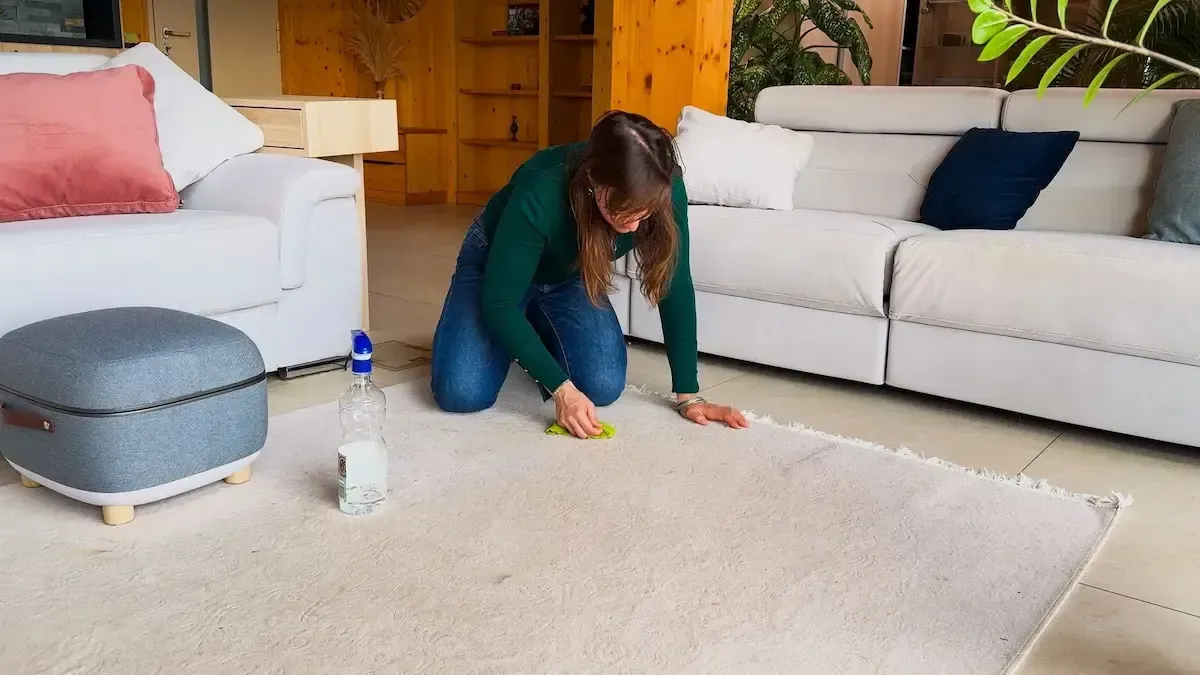
Finally, there is the issue of physics. When you use a spray-and-scrub method, your primary tool is downward pressure.
By scrubbing a stain, you are inadvertently doing three things:
- Driving the liquid down: You push the contaminant downwards and deeper into the fibres.
- Creating a "wicking" problem: As the carpet dries, stain residues (notably blood, grease, oil) travel back up the fibres (like a candle wick), bringing the stain back to the surface.
- Altering the pile: You can damage the physical structure of the yarn, creating a "fuzzy" patch that catches the light differently (this is often mistaken for a stain).
Professional stain treatments use “top-down chemistry” and "bottom-up extraction" to ensure the best removal possible.
Don't Be a Chemist, Call One
We understand the urge to “DO SOMETHING” the moment a spill happens. But in the world of professional textile care, the best guide is a famous one: “First, do no harm”.
Only blot the spill gently with a dry, white towel to absorb the excess liquid, and then stop. Don't reach for the supermarket spray. Don't reach for the vinegar or the baking soda (which creates its own set of pH nightmares).
You can love the rest of Nana’s DIY tips, but your carpet is a complex structural investment made of natural and synthetic polymers. It deserves the care of someone who understands the molecular science of stains.
At Advanced Carpet Cleaning, we have spent over 30 years mastering the chemistry of Christchurch’s carpets. We have what it takes to safely treat stains without well-intentioned but costly rookie mistakes.
Save your carpet, save your warranty, and save your Saturday. When the spill happens, call the experts on 0800 566 576. We’ll handle the molecules; you just enjoy the results.